
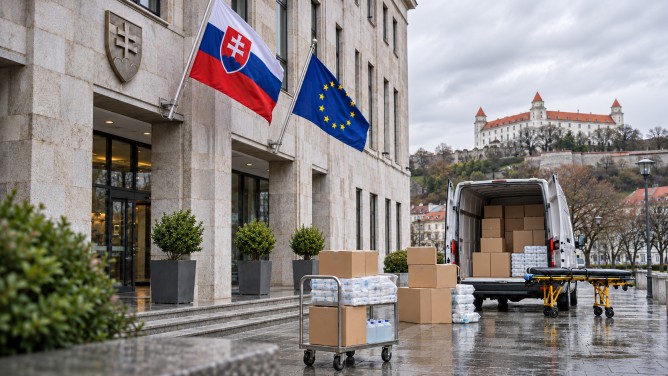
Slovakia has decided not to participate in the European Union’s proposed €45 billion loan programme for Ukraine, as announced by Prime Minister Robert Fico. Instead, Slovakia will focus on offering humanitarian assistance to Ukraine, distancing itself from financial commitments tied to the ongoing conflict.
Fico emphasized Slovakia’s stance against providing financial support that could be linked to military activities, arguing that such aid might prolong the conflict. He noted that Slovakia similarly declined participation in a previous €90 billion EU loan package. The prime minister’s decision comes amid pressure from German Chancellor Friedrich Merz, who has advocated for stronger financial commitments from EU member states to support Ukraine through 2027.
The decision underscores a growing divergence among European nations regarding the financial strategies to support Ukraine, highlighting the challenges of distributing the financial burden within the EU. This issue is anticipated to be a topic of discussion at an upcoming meeting in Bratislava on November 23, which will include leaders from Slovakia, Poland, Hungary, the Czech Republic, and Austria.
These discussions are set to precede the EU summit in Brussels on November 26-27, where European leaders will deliberate on the bloc’s proposed €1.78 trillion budget for 2028-2034. This financial framework includes plans for continued support to Ukraine through a dedicated funding reserve.
Slovakia’s decision not only reflects its commitment to humanitarian aid but also signals a broader debate within the EU about how to effectively and equitably finance Ukraine’s needs in the face of ongoing conflict. The outcome of these discussions will likely shape future EU policies and the financial landscape for Ukraine.