
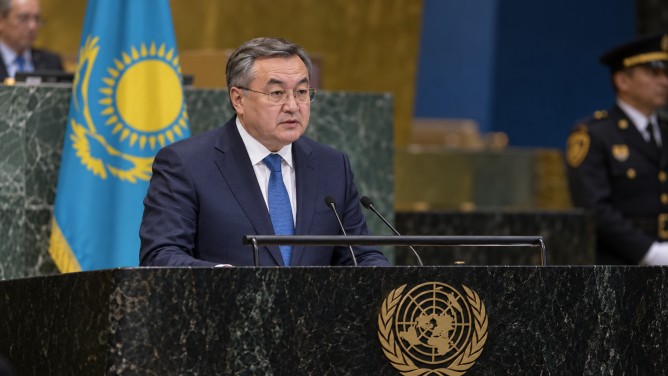
During a recent address to the United Nations General Assembly, Kazakhstan’s Foreign Minister Mukhtar Tileuberdi emphasized the need for renewed diplomatic efforts to resolve global conflicts and strengthen international cooperation. Highlighting a growing deficit of global trust, Tileuberdi urged nations to prioritize diplomacy and negotiations, particularly in light of ongoing conflicts such as the war in Ukraine.
Tileuberdi condemned recent drone attacks on Kazakhstan’s oil export infrastructure and commercial vessels in the Black Sea, warning that such actions pose risks to international trade and global energy supplies. These concerns underscore Kazakhstan’s call for a diplomatic approach to resolve such tensions.
In his address, Tileuberdi also reiterated Kazakhstan’s commitment to a two-state solution in the Middle East, advocating for the peaceful coexistence of an independent Palestinian state alongside Israel. Kazakhstan expressed its willingness to support international efforts to stabilize Gaza through initiatives focused on civilian reconstruction, food security, and digital governance. Additionally, Tileuberdi announced Kazakhstan’s intention to join the Abraham Accords, enhancing its engagement in the region.
Turning to Central Asia, Tileuberdi emphasized the importance of Afghanistan’s stability for regional security and development. He called for coordinated international efforts, facilitated by the United Nations, to address humanitarian needs while also focusing on long-term solutions for poverty and economic dependence in Afghanistan.
On the topic of nuclear disarmament, Tileuberdi renewed Kazakhstan’s call for progress and offered to host high-level discussions among nuclear-armed states. He expressed concern about the weakening of global arms-control efforts and urged continued commitment to disarmament. Kazakhstan’s experience in closing the Semipalatinsk nuclear test site and relinquishing its inherited nuclear arsenal serves as a foundation for its advocacy in this area.
Tileuberdi concluded by advocating for greater representation of Asia, Africa, Latin America, developing countries, and middle powers within the UN Security Council. In addition to his General Assembly address, he engaged in discussions with UN officials and foreign ministers on various topics, including UN reform, regional connectivity, and sustainable development initiatives in Central Asia and Afghanistan.