
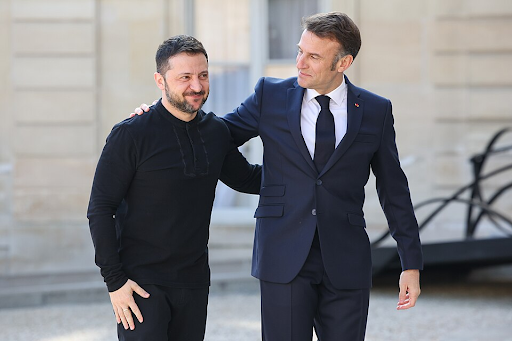
In a significant strategic move, Ukrainian President Volodymyr Zelensky has secured a preliminary agreement with France to purchase as many as 100 Rafale fighter jets, manufactured by Dassault Aviation. This landmark letter of intent was finalized during Zelensky’s pivotal trip to Paris, marking one of the most substantial defense agreements for Ukraine in recent history. The news was met with enthusiasm in the financial markets, causing shares in Dassault Aviation to surge by as much as 8% in Paris trading, reflecting the magnitude of the potential order.
The deal, which President Zelensky celebrated as a “special moment, really a historical one for both nations,” is a direct response to Kyiv’s urgent need to bolster its air defenses. For months, Russia has significantly escalated its air strikes across Ukraine, deploying a devastating combination of missiles, drones, and glide bombs. These attacks have not only claimed civilian lives but have also crippled critical infrastructure, leading to rolling blackouts as the country braces for another harsh winter. Zelensky has consistently stated that acquiring more fighter jets and air-defense systems is Kyiv’s absolute top priority.
The agreement’s scope extends far beyond the fighter jets, outlining a comprehensive 10-year defense partnership. The letter of intent also includes plans for Ukraine to acquire advanced air defense systems, modern radars, and unmanned aerial vehicles (drones). This holistic approach aims to create a multi-layered and resilient air shield capable of countering the diverse threats posed by the Russian military. Each project within this decade-long agreement will be subject to its own individual contract, allowing for phased implementation.
However, the arrival of the first Rafale jets is not imminent and hinges on several key factors. A person familiar with the sensitive discussions indicated that the delivery timeline will depend on two major bottlenecks: the speed at which Ukrainian pilots can be successfully trained to operate the sophisticated aircraft and the development of the necessary ground infrastructure within Ukraine to support and maintain the new fleet. This highlights the long-term nature of the commitment from both Paris and Kyiv.
Financing for this massive undertaking will be sourced from a variety of mechanisms, reflecting the new geopolitical reality of European-led support. The French presidency stated that funding would be determined by the individual contracts, with some resources coming from the European Union’s €150 billion Security Action for Europe (SAFE) loan fund. Furthermore, Zelensky confirmed in Paris that Kyiv will aim to deploy funds from a Group of Seven mechanism, which provides resources backed by future revenue generated from frozen Russian assets, a complex plan the EU is still working to finalize.
Ukraine Secures Landmark Deal for 100 French Rafale Jets
Picture Credit: www.commons.wikimedia.org
42