
Standing within the ancient Tregeseal stone circle near St Just, visitors encounter granite monuments that glow against the somber moorland like silent sentinels from millennia past. The landscape stretches toward Carn Kenidjack, a dramatic rock formation piercing the horizon, while local folklore speaks of mystical creatures and supernatural beings that roam these moors after nightfall.
Archaeoastronomer Carolyn Kennett has dedicated her research to understanding how Cornwall’s ancient landscapes align with celestial events. Her findings suggest the entire Land’s End peninsula functions as a prehistoric winter solstice observatory, with its granite spine oriented toward the midwinter sunset. The positioning of monuments like Chûn Quoit demonstrates sophisticated astronomical knowledge among Neolithic builders.
The Tregeseal circle appears deliberately placed to frame views of the Isles of Scilly during sunset on the shortest day. These distant islands vanish and reappear depending on atmospheric conditions, creating an ethereal quality that ancient peoples may have associated with spiritual realms. The circle’s builders potentially viewed Scilly as a threshold between worlds, connected to themes of death and renewal.
Nearby, the enigmatic Kenidjack holed stones present archaeologists with enduring mysteries. Unlike their more famous cousin at Mên-an-Tol, these stones feature small apertures close to ground level. Kennett proposes they functioned as a solar calendar, with rising sun beams creating changing shadow patterns from October through December, helping prehistoric communities mark time’s passage toward the solstice.
Modern celebrations continue these ancient traditions through festivals like Montol, where Penzance transforms into a scene of revelry with masked dancers, flaming torches, and the ritual burning of symbolic sun effigies. The peninsula’s prehistoric monuments, from solitary standing stones to sacred circles, remain focal points for contemporary solstice observers seeking connection with both landscape and heritage. This convergence of ancient astronomy, folklore, and living tradition makes West Penwith uniquely powerful during winter’s darkest moment.
Ancient Stones Reveal Cornwall’s Sacred Connection to Winter’s Darkest Day
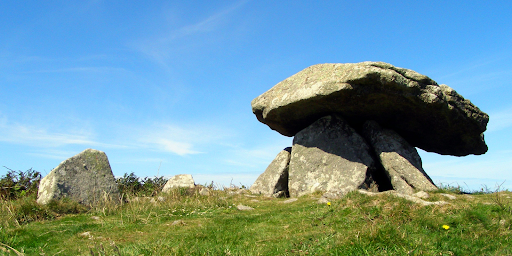
Photo by Jim Champion (treehouse1977), via wikimedia common
26