
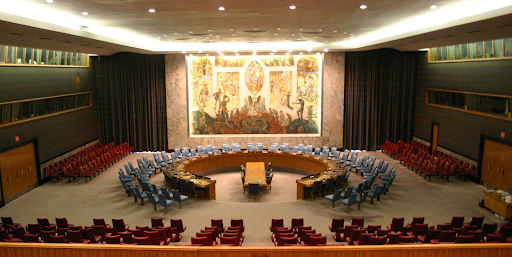
The United Nations Security Council has officially endorsed President Donald Trump’s comprehensive 20-point plan aimed at ending the protracted two-year conflict in Gaza. The US-drafted resolution, adopted on Monday, authorizes the creation of an international stabilization force (ISF) for the Palestinian enclave, a move seen as crucial for implementing the plan’s ambitious goals. This resolution’s passage is a significant diplomatic victory for the United States, which has been pushing for a new framework to address the long-standing crisis. The plan itself was partially set in motion last month when Israel and Hamas agreed to its first phase, involving a ceasefire and the release of hostages.
The core of the newly legitimized plan rests on two main pillars: a transitional governance body and a robust security mechanism. The resolution establishes the “Board of Peace,” a transitional authority chaired by Trump himself, which will be responsible for overseeing the monumental tasks of reconstruction and economic recovery in war-torn Gaza. Concurrently, it green-lights the ISF, an international military body with a clear mandate to ensure the complete demilitarization of Gaza. This force is empowered to decommission all weapons and methodically destroy any remaining military infrastructure, fundamentally altering the security landscape.
However, the plan immediately faces significant opposition from the very group it seeks to disarm. Hamas issued a strong statement following the vote, categorically rejecting the resolution as an “international guardianship mechanism” that its people will not accept. The militant group doubled down on its refusal to disarm, asserting that its ongoing fight against Israel constitutes legitimate resistance. This defiant stance potentially sets Hamas on a direct collision course with the newly authorized international stabilization force, casting a shadow over the plan’s feasibility.
The vote itself revealed deep divisions within the Security Council. While the resolution passed, it did so without the support of two veto-wielding permanent members, Russia and China, which both abstained. Their ambassadors voiced strong complaints, pointing out that the resolution fails to carve out a clear, defined role for the United Nations in Gaza’s future. Russian ambassador Vasily Nebenzya criticized the council for essentially “giving its blessing” to a US-led initiative based on promises, ceding “complete control” to the Board of Peace and ISF, the precise workings of which remain unknown.
Despite the high-level abstentions and Hamas’s rejection, the US remains optimistic. Ambassador Mike Waltz portrayed the resolution as a historic “pathway for Palestinian self-determination,” where “rockets will give way to olive branches.” Trump echoed this, calling it a “moment of true Historic proportion.” In a move that diplomats said was crucial to averting a Russian veto, the Palestinian Authority welcomed the resolution and signaled its readiness to participate in implementation, adding another complex layer to the region’s rapidly shifting political dynamics.
Trump’s Gaza Plan Gets UN Green Light: Security Council Approves US-Led Resolution
Picture credit: www.commons.wikimedia.org
44